Introducing Agentic TMS: The Agentic TMS for Freight Forwarders and Customs Brokers
AI agents run the grunt work of every shipment; your team supervises and makes the decisions.
Ask a freight forwarder what’s wrong with their tech stack and you’ll usually hear “too many tools.” That’s not actually where the day gets lost.
Walk the floor of most forwarders and the real system in use is a rate sheet in Excel, a shipment tracker in a second spreadsheet, and an inbox that’s the only record of what a carrier promised or a customer asked for. Coordinators aren’t waiting on software. They’re waiting on a reply, then updating a cell by hand once one arrives. That’s the job today, and it’s the job Agentic TMS is built to change: an agent should be running that grunt work, not a person.
Software fragmentation makes it worse, but it’s a secondary problem, not the root one. A legacy TMS is heavy to configure and slow to change; point tools and RPA bots get bolted on to cover the gaps and none of them share a record of the shipment. Even where the software is fine, the actual coordination — confirming a booking, chasing a document, telling a customer where things stand — still happens by hand, in an inbox and a spreadsheet.
That split shows up the moment a shipment crosses a desk. Sales quotes it in one system. Operations re-keys it into another to actually book and move it. Customs works from a filing that references the shipment number but isn’t structurally connected to it. Finance reconciles a carrier invoice against numbers that were typed in three separate times, by three separate people, none of whom can fully trace them back to the original booking. And underneath every one of those handoffs is the same manual loop: email the carrier for a confirmation, wait, hear nothing, re-ping, get a document back from the customer, then open the spreadsheet and update it by hand before anyone downstream can trust it. Today, the human is the integration layer — and firefighting mode is what happens when that layer gets overloaded.
Agentic TMS, Deep Cognition’s Agentic Transportation Management System, was built on a different division of labor for the agentic era: the agent handles the grunt work, and the human supervises and spends their time making decisions. Reading inbound emails, updating records, chasing the confirmations and documents that used to sit in someone’s inbox — that’s agent work now. Deciding which carrier to book, whether to release a hold, whether a payment is good to approve — that stays with your team. Not more software to configure, but a working AI team you approve, correct, and direct.
One Shipment. One AI Team.
A shipment on Agentic TMS is a single, living record from the first customer inquiry through quoting, booking, customs, delivery, and final invoicing. Every desk that touches it — sales, operations, customs, finance — opens the same record instead of recreating its own copy. That single change removes most of the handoff loss, because there’s no longer a version of the shipment that only exists in one person’s inbox or spreadsheet.
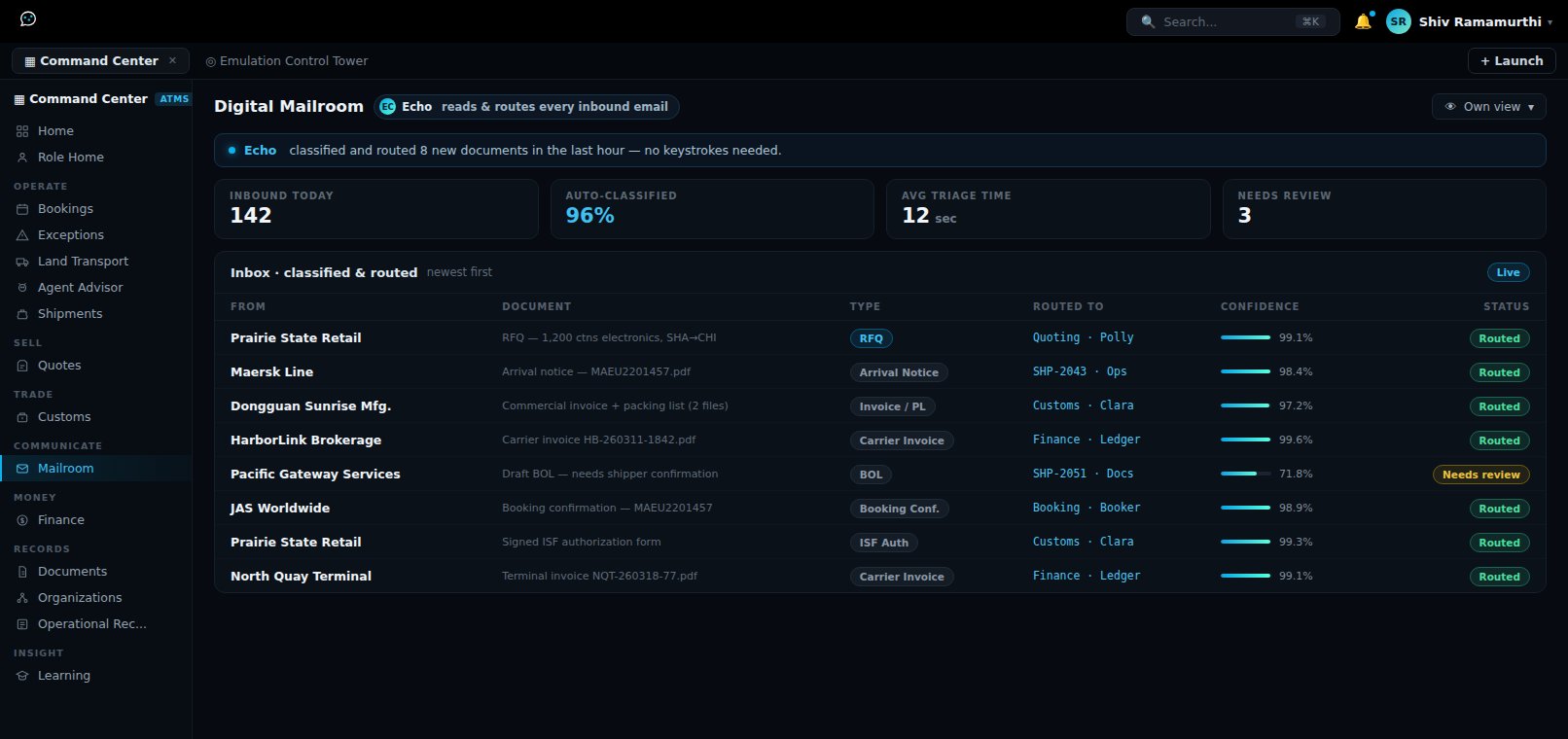
An AI Team That Works the Desk With You
What separates Agentic TMS from a traditional TMS isn’t only that it’s one platform — it’s what’s running underneath it. Instead of static software that only records what your team already did, Agentic TMS puts a team of AI agents to work alongside your staff, each one scoped to a specific, well-defined part of the job: reading an inbound customer request and drafting a quote, preparing a carrier booking, chasing a confirmation or a missing document, checking a customs filing against the shipment’s documents, matching a carrier invoice against the original rate and booking.
Your team makes the calls that carry weight: which carrier to book when two quotes are close, whether to release a hold on a shipment, whether to approve a payment that doesn’t quite match the invoice. Every one of those decisions is routed to a person before it happens, and you decide, task by task, how much autonomy an agent is trusted to handle on its own — from “draft and wait for approval” to “execute automatically within these bounds.” It’s less like adopting new software and more like adding a team of tireless junior staff who never miss a step, always with a person keeping the final say.
A Day in the Life of a Coordinator
- Opens one view already updated with what the agents completed overnight, and approves the handful of exceptions flagged for a decision.
- Reviews a carrier decision the system has already prepared, and approves it in one click.
- Sends a customer update straight from the shipment record instead of writing a separate email.
- Catches a customs hold the agent flagged before it delays a delivery.
- Hands off the shift with nothing left sitting in anyone’s head — it’s all visible to whoever picks up next.
Why It Matters
| Legacy TMS | Spreadsheets + Email | Agentic TMS | |
|---|---|---|---|
| Shipment record | One system, slow to adapt | Fragmented across files and inboxes | One system, one record |
| New work types | Custom configuration | A new tab or template | Modular, extends per role |
| Repetitive work | Manual, human-driven | Manual, human-driven | AI agents, supervised |
| Exceptions | Reactive, found late | Missed until someone checks | Flagged proactively, routed to the right role |
| Human control | Full, but slow | Full, but inconsistent | Full — agent autonomy set per task |
Built for Freight, Not Retrofitted From Something Else
Agentic TMS wasn’t adapted from a general-purpose workflow tool — it was built around how freight actually moves and how forwarders and customs brokers actually work. That shows up in the details that matter to evaluators: a full audit trail of every action taken by a person or an agent, a platform that scales from one branch to many without re-architecting, and an approach to AI autonomy that always leaves a human in control of the decisions that carry real weight.
Because every shipment lives on one record with one history, month-end reporting, margin tracking, and compliance reviews pull from the same source everyone worked from all month — instead of being reconstructed after the fact from exports out of five different tools.
For Technical Evaluators
What is an Agentic TMS?
A traditional TMS records what your team already did. An Agentic TMS puts AI agents to work on the shipment itself: reading inbound emails, preparing bookings, chasing confirmations and documents, and flagging exceptions, while every consequential decision still routes to a person. It’s software that works the desk alongside your team, not just software that logs the outcome afterward.
Audit trail and compliance
Every action on a shipment, whether taken by a person or an agent, is logged against the same record: what changed, who or what changed it, and when. That single trail is what a compliance review or customs audit pulls from, instead of being reconstructed after the fact from emails and spreadsheet versions.
Scaling from one branch to many
Every shipment lives on one record with one permission model, so adding a branch means adding users and queues, not standing up a parallel instance or remapping data. Role-based views for coordinators, brokers, pricing, and finance carry over branch to branch without reconfiguration.
Does Agentic TMS replace freight forwarding staff?
No. Agents take on the repetitive, high-volume parts of the job — reading requests, prepping bookings, chasing confirmations, matching invoices — so your team spends its time on the calls that need judgment: which carrier to book, whether to release a hold, whether to approve a payment. Every consequential decision still goes to a person.
How does a team roll Agentic TMS out?
Most teams start with one workflow or branch, running agents in a “draft and wait for approval” mode while staff get comfortable with what the system is doing. Autonomy expands task by task from there, and only where a team decides it should, with the audit trail giving full visibility throughout.
Less Time Chasing Paper. More Time Making the Decisions That Move Freight.
See the 3-minute demo and book 30 minutes — we measure the savings on your own files, not industry averages.