


IN THIS BLOG
ToggleIn customs brokerage, the most expensive problems are rarely the urgent ones. They are the recurring operational tasks that appear across hundreds of entries, consume licensed brokers’ time, and force experienced teams to spend hours on manual line-level work instead of higher-value compliance decisions.
Section 232 has become one of those tasks.
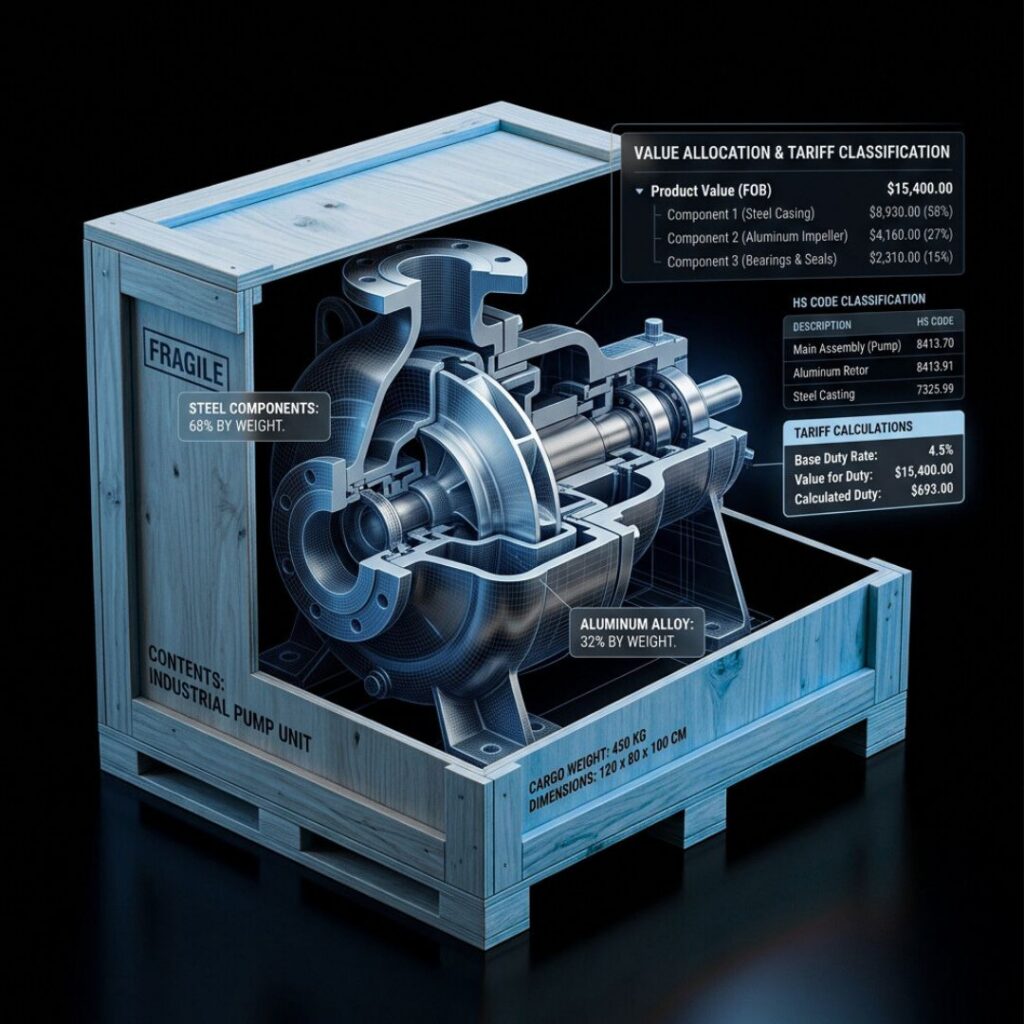
Importers of steel and aluminum products generally understand the regulation itself. The real burden appears during entry preparation, where customs brokers and freight forwarders must operationalize the requirement. When a shipment contains partial steel or aluminum content, brokerage teams must separate the portion subject to Section 232 duties from the portion that is not dutiable.
At that point, a compliance rule becomes an operational workflow problem. Brokers must verify material composition, determine the value allocation, split entry lines correctly, apply the proper tariff treatment, and confirm the supporting documentation justifies the value split in case CBP reviews the entry during release, post-summary correction, or audit.
Where Section 232 creates operational friction
The difficulty with Section 232 is not determining whether the duty applies. The real challenge is executing that determination accurately and consistently at the entry line level.
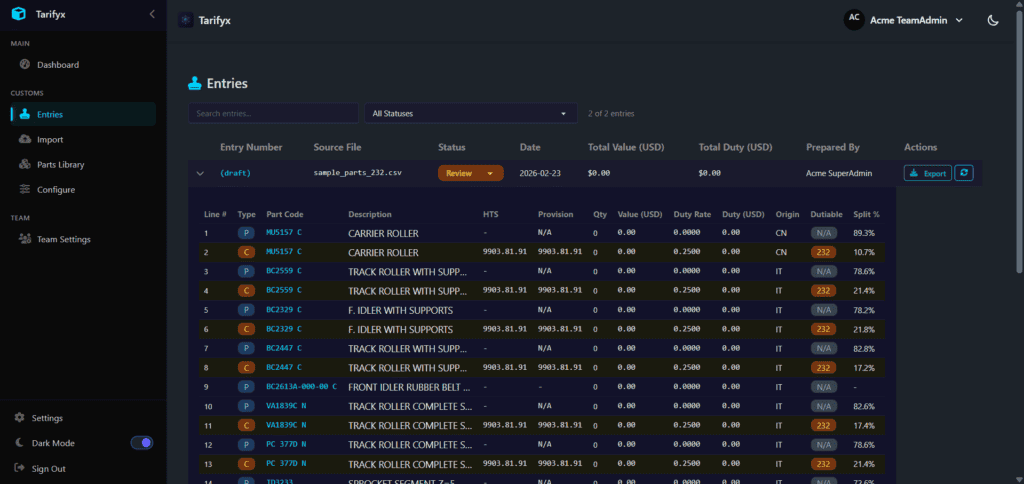
If a product contains steel or aluminum but is not entirely subject to Section 232 duties, the entry line must be split. One line captures the value subject to the additional duty, while another reflects the remaining value. In many brokerage operations, this process is still handled manually.
Brokers must review invoices, identify material composition, calculate the duty-applicable value, rebuild the line detail, and verify the tariff treatment before the entry can move forward. The operational impact is predictable: licensed brokers get pulled into repetitive line construction work rather than focusing on compliance review and exception handling. Entry preparation slows as volume increases, and consistency becomes dependent on individual experience rather than a standardized process.
For brokerage leadership, this creates a familiar pattern. Operational effort increases with shipment volume while efficiency and margin gradually decline.
How Tarifyx automates Section 232 entry preparation
Tarifyx is part of the PaperEntry AI ecosystem by Deep Cognition, extending the platform’s capabilities into tariff compliance and duty calculation workflows. It automates Section 232 entry preparation end to end.
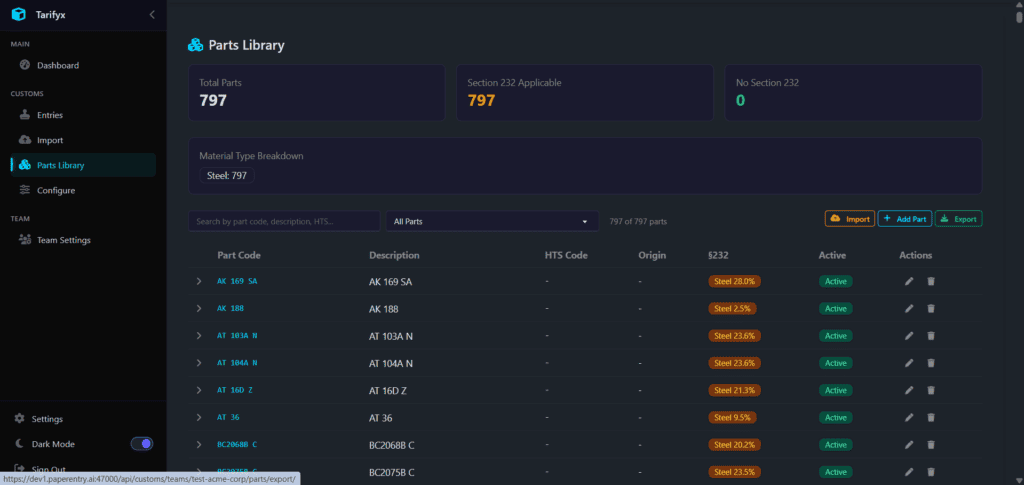
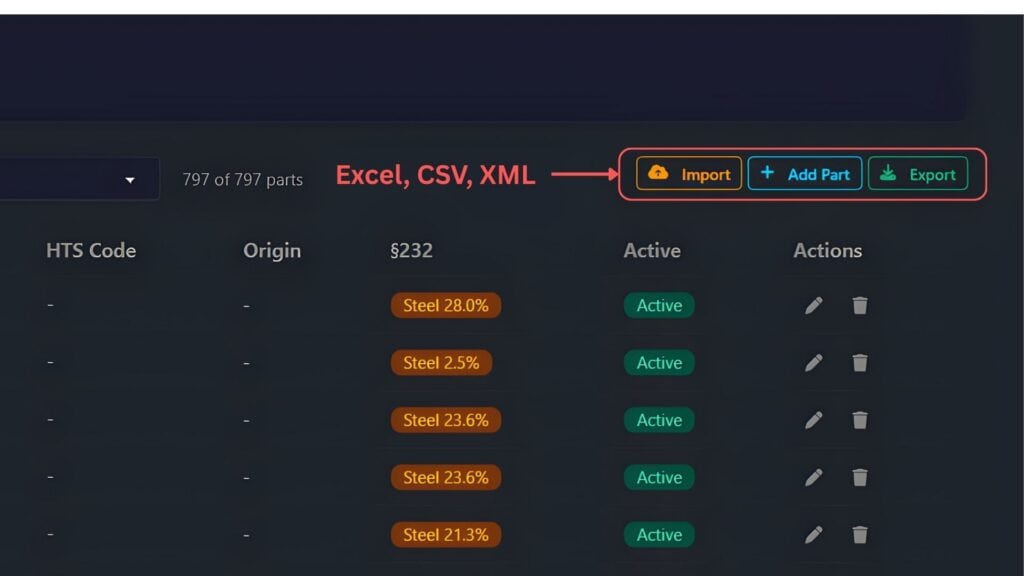
The platform starts with structured data intake from commercial invoices, shipment records, and other entry data already available within brokerage systems. It maps part numbers against a centralized parts database that identifies steel or aluminum content at the part level. Brokerage teams can manage and update these records as product specifications, sourcing, or compliance requirements change.
Tariff logic is then applied based on commodity classification, country of origin, and duty treatment. When Section 232 requires value apportionment, Tarifyx automatically generates the dutiable and non-dutiable line detail and calculates the corresponding duties. The system handles the operational steps that brokerage teams currently perform manually:
- Identifying steel or aluminum content at the part level
- Calculating duty-applicable value allocations
- Automatically splitting entry lines when Section 232 applies
- Applying HTS and Section 232 duties
- Generating structured output for broker review and filing
Material composition data is referenced consistently. Value allocations are calculated systematically. The resulting line detail is structured, reviewable, and easier to support if CBP questions the entry later.
Automatic CBP duty rate synchronization
A key capability within Tarifyx is automatic duty rate synchronization with the CBP tariff schedule. The platform keeps duty rates current by syncing on an ongoing basis using the HTS code, country of origin, and CIV and parts database information.
Brokerage teams do not need to manually maintain duty rate tables or repeatedly verify rates during entry preparation. This ensures calculations reflect current tariff rules while improving confidence in the accuracy of every filing.
Integration with existing brokerage systems
Customs brokers operate across a range of entry preparation systems — ABI software, transportation management platforms, and spreadsheet-driven workflows. Tarifyx integrates into those environments rather than replacing them.
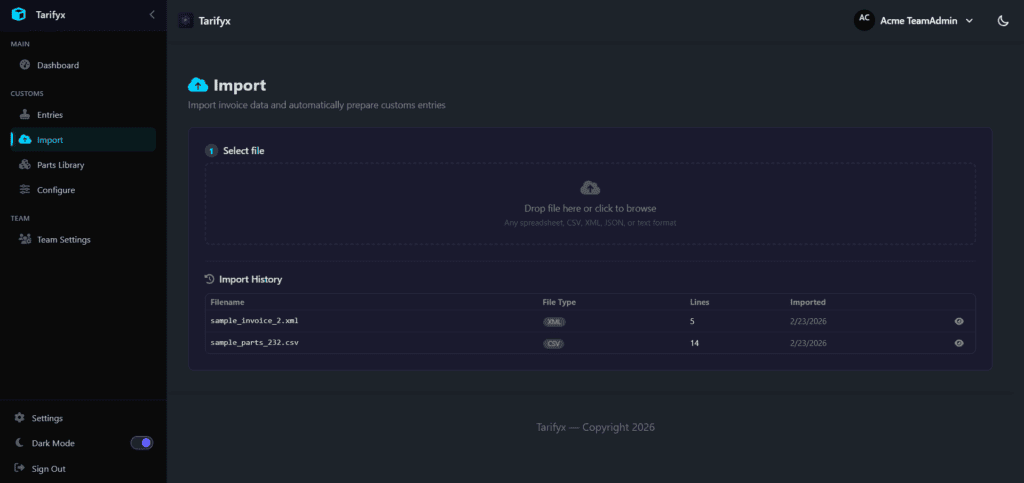
The platform supports API-based integration, allowing brokerage firms to connect Tarifyx directly into existing entry preparation pipelines. It accepts data in Excel, CSV, XML, or JSON formats and can generate output in the format required by the downstream system. Teams can also upload custom export format templates, so output matches their existing filing software without needing to redesign established workflows.
Operational impact
For brokers and entry writers, the most immediate change is the removal of repetitive manual work. A Section 232-affected line that might require fifteen to thirty minutes of manual preparation can be processed in less than a minute with Tarifyx. The platform performs value apportionment, creates the required line splits, and applies the correct tariff treatment automatically.
As a result, brokers spend less time reconstructing entry lines and more time reviewing filings, resolving exceptions, and addressing compliance questions that require professional judgment. The system handles repeatable entry mechanics while the broker retains oversight and decision-making authority.
For operations leaders and executives, the value extends beyond individual entries. Standardized logic improves consistency, reduces reliance on individual knowledge, and allows entry preparation to scale without increasing manual workload. In a regulatory environment where tariff complexity continues to grow, structured workflows are essential for maintaining both efficiency and compliance confidence.
Core capabilities
- Automated Section 232 line splitting based on material composition
- Centralized parts database for managing steel and aluminum content
- Automatic synchronization with CBP duty rates
- Stacked tariff calculations for base HTS duties and Section 232 duties
- Multi-currency and country of origin handling
- API integration with flexible data formats (Excel, CSV, XML, JSON)
- Custom export format templates for downstream system compatibility
- Compliance audit trails that preserve calculation logic
- Role-based access controls for operational governance
- Supplier communication tools for collecting missing product information
Why this matters now
Section 232 highlights a broader challenge across customs operations. Many entry workflows still depend heavily on manual effort in areas where tariff logic can already be standardized. That model slows throughput, increases operational cost, and introduces unnecessary risk into routine processes.
Tarifyx addresses this by replacing manual line splitting and duty calculations with a structured, repeatable workflow. For customs brokers, this means fewer operational bottlenecks. For freight forwarders, it enables more scalable entry preparation. For leadership teams, it provides a stronger operational foundation for managing tariff complexity.
Tarifyx is not about automating a single tariff rule. It removes a persistent operational constraint from U.S. import workflows.
See Tarifyx in action
If your brokerage team is still handling Section 232 splits manually, there is a more efficient approach.
Schedule a demo to see how Tarifyx integrates with existing brokerage systems and reduces entry preparation time, or contact the Deep Cognition team at deepcognition.ai to learn more.