Multi-tenancy, role-based access, and human-in-the-loop autonomy: the platform architecture that makes an Agentic TMS safe to run at enterprise scale.
An Agentic TMS doesn’t earn enterprise trust through its agents alone. It earns it through what sits underneath them: who can see what, who approves what, how much an agent is allowed to do on its own, and whether every one of those decisions is provable after the fact. These are the four functions IT, security, and operations leadership look for before an agentic system touches production freight.
Agentic TMS is multi-tenant software by design: every customer, business unit, or regional office runs in its own isolated workspace, its own data, users, rates, carriers, and configuration, on shared infrastructure underneath. A workspace’s shipments, documents, and pricing are never visible outside it, and that isolation is enforced by the platform’s multi-tenant architecture itself, not by training or process.
For a forwarder running multiple offices, brands, or acquired entities on one instance, this multi-tenant SaaS security model is what keeps one branch’s rates invisible to another branch’s sales team without maintaining six separate logins or six separate systems.
Every user gets exactly the access their role requires and nothing more, role-based access control (RBAC) enforced automatically instead of left to convention. Sales sees rates and quotes. Operations sees bookings and milestones. Finance sees invoices and margin. TMS user permissions are defined once per role and applied everywhere an agent or a person touches the system, not left to whoever remembers to lock down a shared login or a shared inbox.
The same RBAC boundaries apply to agents, not just people. A pricing agent can quote a rate without ever seeing invoice data, and a customs agent can file an entry without touching a sales rep’s rate sheet.
Every agent in Agentic TMS runs inside an autonomy setting your team controls, per agent, per operation, Agentic TMS’s approach to human-in-the-loop AI and agent governance. The L1 to L5 model below sets exactly how much independence an agent has, from drafting a suggestion for a person to act on, to acting fully within policy with no case-by-case review.
| Level | What the agent does | The human’s role |
|---|---|---|
| L1 | Drafts a suggestion only, for example a quote or a customs field. | Reviews and completes every action manually. |
| L2 | Prepares and stages the action, for example a filed entry or a sent quote. | Approves before anything goes out (draft-and-approve mode). |
| L3 | Acts automatically on routine cases inside a defined threshold, for example quotes under a set margin variance. | Reviews a digest; approves anything above the threshold. |
| L4 | Acts automatically across the workflow, escalating only what it flags. | Intervenes only when an agent raises something. |
| L5 | Acts fully autonomously within policy. | Audits the trail; no case-by-case review. |
Most Agentic TMS customers start every agent at L1 or L2 in a Training sandbox, then raise autonomy workflow by workflow as trust builds, never as a single all-or-nothing switch, the same staged approach to autonomous AI agent oversight enterprise AI governance teams expect.
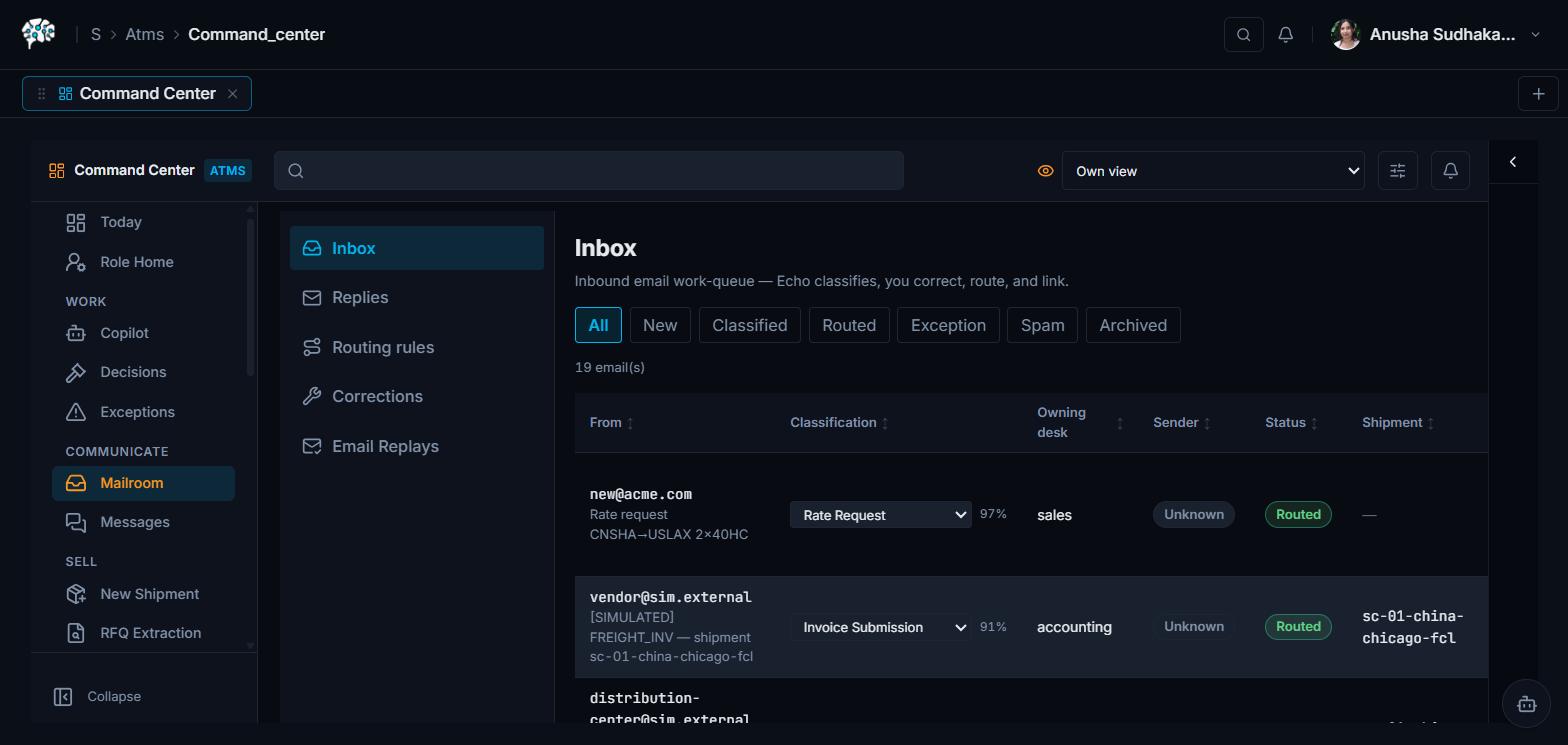
Every inbound email, PDF, and attachment, across every channel and every tenant, is read, classified, and routed automatically before a person opens it, automated document routing that turns a bill of lading or an invoice into structured data without anyone typing it in by hand. That data lands in the right shipment and the right desk without anyone forwarding, saving to a shared drive, or manually filing a single document.
Customs entry automation is a core function of the platform, not an add-on. PaperEntry AI: Customs turns the documents behind a shipment into a validated, filed entry, and pulls a person in only when a check fails.
Alongside Digital Mailroom and Customs, the platform runs accounts payable end to end. PaperEntry AI reads supplier invoices, reconciles them against your purchase orders and receipts, and posts clean, approved payables into your finance system, so your team reviews exceptions instead of keying documents.
Talk to our team about tenancy, access control, and how autonomy is governed in your environment. These are the agentic TMS architecture questions an enterprise TMS platform has to answer before your team ever touches a live shipment.