
How the Platform Works
Run a modern freight-forwarding desk with an AI agent fleet at your side. Agents recommend and prepare the work; you approve the decisions that matter and set how far agents can go on their own.
What Makes It Different
You Approve at the Gate
An agent can stage the quote, the booking, or the entry, but the consequential call stays with a person. How much an agent may do on its own is a setting you control.
Practice Safely
A built-in Training sandbox and Demo mode let your team rehearse realistic scenarios with synthetic data. Nothing you do there touches production.
Documents
Sandbox
Data
One Shared Operation, Many Desks
After you sign in, you pick a workspace, a company or branch context. Inside it you get a dashboard of applications (the platform calls them applets). Each app is a focused tool, but they share the same shipments, organizations, and documents underneath.
The flagship Agentic TMS My Desk pulls every desk into a single view. Most daily work happens there, and the individual apps are the detailed views behind it.
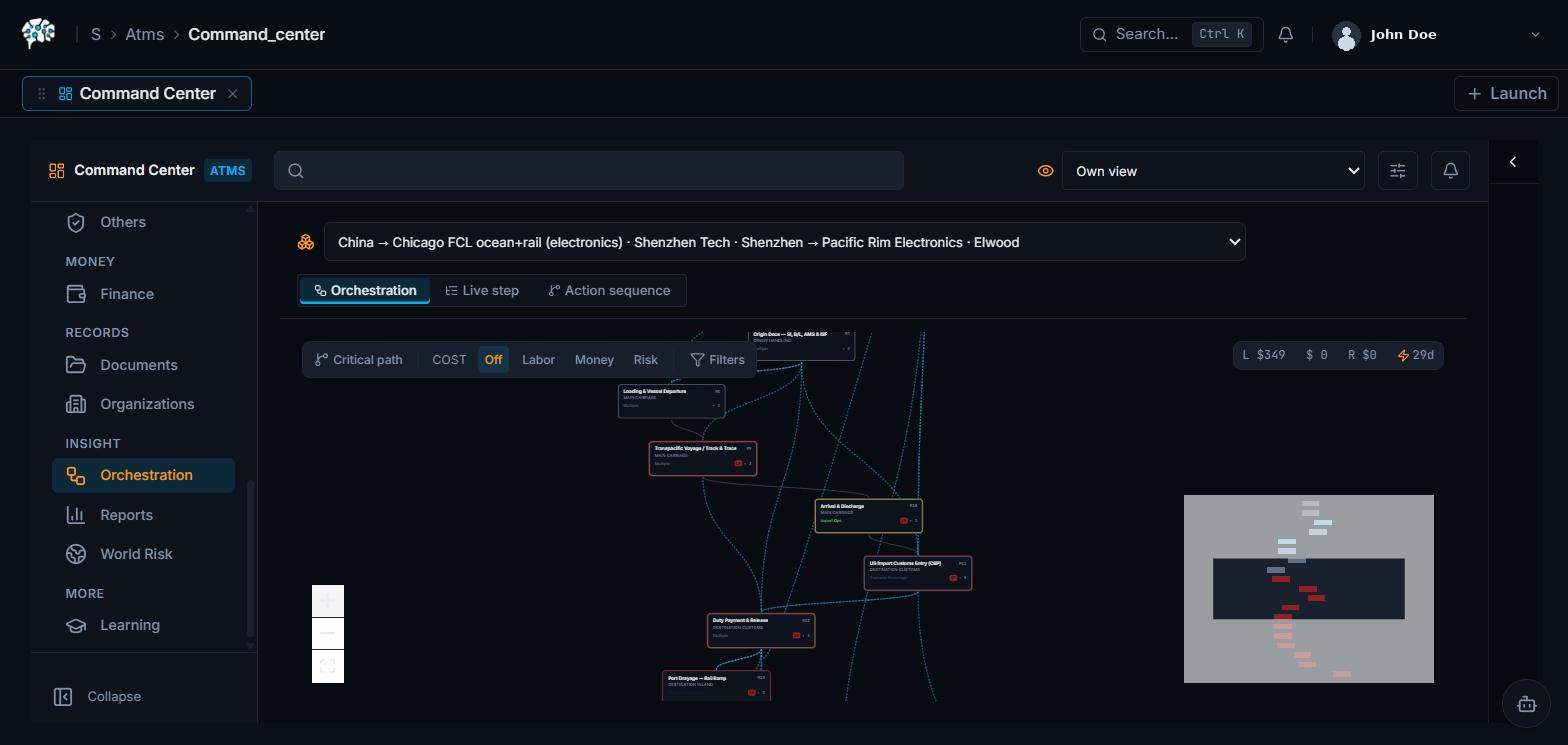
Orchestration: One Command Center, Every Agent’s Status
Every agent reports into the Command Center: live status across every open shipment, the autonomy setting for each agent, and disruptions flagged before they become a cost. It’s what makes the agent fleet behave like one accountable system instead of a set of disconnected tools each running its own workflow.
The L1 to L5 Model: You Set How Far Agents Go
Every kind of action has an autonomy level that decides how much the agent may do without you. Admins set these, and a rule engine can override them for specific situations.
| Level | Name | What happens |
|---|---|---|
| L1 | Manual | The human does the work; the agent stays out of the way. |
| L2 | Assisted | The agent suggests, the human does the action. |
| L3 | Supervised | The agent prepares and proposes; the human approves at a decision gate before it fires. |
| L4 | Autonomous | The agent acts on its own; the human can watch and intervene. |
| L5 | Full Auto | The agent handles it end to end, no human step. |
The Decision Gate
The decision gate is the moment an agent pauses and asks a human to approve an important choice: which carrier, whether to pay an invoice, whether to release a hold. Approvals you owe show up in the Approval Inbox.
Exceptions & Decisions: One Queue, Not Six Alerts
A rolled booking, a denied-party hit, a rate variance, a low-confidence document field: every exception any agent surfaces lands in one queue instead of scattered alerts across email, chat, and dashboards. Each item carries what happened, what the agent recommends, and what’s at stake if it’s wrong, so whoever’s on the hook isn’t starting from a blank screen.
SLA buffer alerts surface the same way, before a carrier rollover or a demurrage clock becomes the thing you’re explaining to a customer.
Rehearse Safely Before You Go Live
The platform can run against real operations (Live) or against deterministic synthetic data for safe practice.
Training Sandbox
Realistic, repeatable scenarios for each role, with synthetic data that never touches production.
Demo Command Center
A pre-flight that verifies a “golden path” will run cleanly before you present to a customer.
Everything Attaches to the Shipment
A shipment is the central record. Around it sit the parties (organizations), the commercial quote, the carrier booking, the customs filings, the documents, and finally the invoices.
How Agentic TMS Is Put Together
Everything that arrives feeds one shipment record; agents do the work on the left, your team approves at the gates on the right, every role gets its own view, and your TMS stays the system of record.
- Read requests · draft quotes
- Prepare carrier bookings
- Chase confirmations & documents
- Check customs filings · match invoices
- Which carrier to book
- Whether to release a hold
- Whether to approve a payment
Frequently Asked Questions
What is the decision gate in Agentic TMS?
How does an Agentic TMS reduce manual data entry?
How does the approval workflow work in Agentic TMS?
What is a unified workspace or “My Desk” view in a TMS?
See It Run Your Operation
Explore the platform in a safe Training sandbox, or book a walkthrough with our team.