


I have spent years on document extraction. PaperEntry AI reads commercial invoices and packing lists for some of the largest brokers and forwarders in the world. I am proud of that work.
But extraction is not the job. The job is the entry.
This fall I sat with a customs brokerage team as they walked us through two workflows: ISF filing, and declaration creation for a new book of business that will scale fast. I want to share what I saw, what we are building for customs brokerage automation, and what I think the benefit looks like.
What Does an ISF Filing Actually Take?
An ISF request arrives as an email. There is a commercial invoice, a packing list, and sometimes a booking confirmation. Ten data elements must reach Customs 24 hours before the container is loaded.
The reading is easy. The matching is not.
The shipper on the invoice must become the right organization record in the TMS. Brokers accumulate duplicate organizations over years. Same name. Same address. Three records. An entry writer knows which one the branch prefers. Software usually does not.
The consolidator is often missing from every attachment. It is in a different email. Or it is in the entry writer’s head.
Then the data has to be keyed into the TMS. One field at a time.
A good entry writer does this in ten to fifteen minutes when nothing is wrong. Something is often wrong.
What Does Declaration Creation Actually Take?
Declaration creation is ISF with the volume turned up.
Each invoice line needs a product code matched against the product database. If the match fails, that line is an exception. If the product has PGA requirements, the data must be present. In most TMS products, PGA data does not carry forward on a product code. Someone re-enters it. Every time.
Then come the rules. Each importer has its own. Round this way. Use this unit of measure for this supplier. Split this invoice by this logic. One brokerage gave us six rules for one importer. They were right that these belong in a lookup table, not in a conversation with an AI.
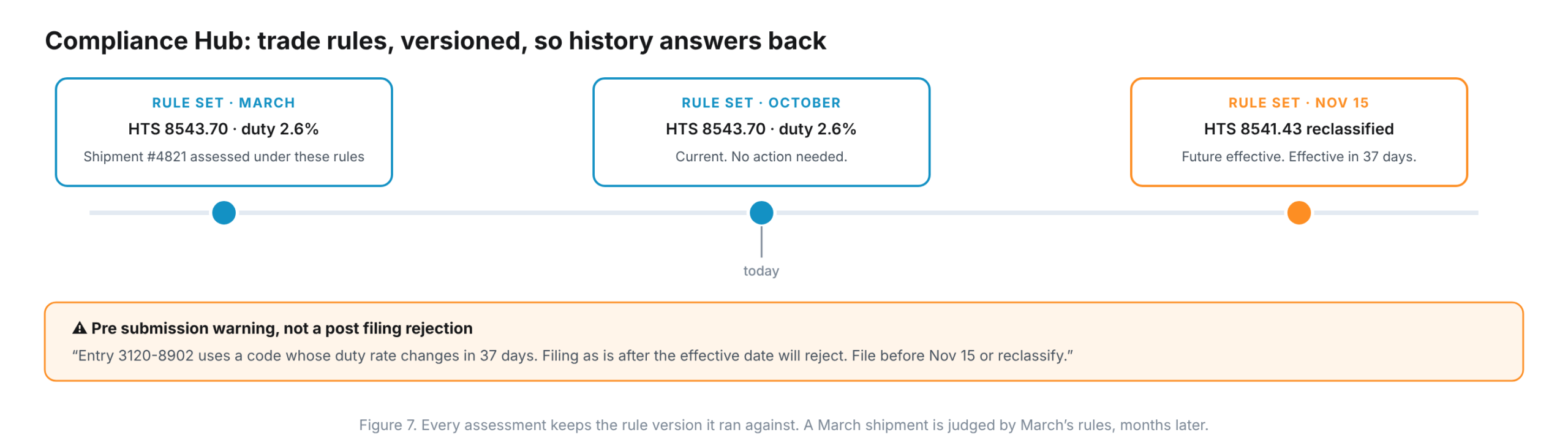
Then come the tariffs. Section 232 on steel and aluminum. Section 301. Chapter 99. A CSMS message that changed the rate this morning. The entry writer is expected to know.
Then the entry is keyed into the TMS. Twenty to forty-five minutes per entry, depending on lines.
The brokerage’s ask was simple. Minimal human intervention. Clean entries go straight to the TMS. Only exceptions come to a person.
Where Does HS Classification Fit?
Classification is where brokers are most careful about AI. I agree with them.
Our position is clear. HS Code Assist is a research tool. It proposes a code with the GRI steps it applied and the ruling it relied on. The licensed broker makes the decision. The decision is stored on the product record with the broker’s name. The next shipment of the same part starts classified.
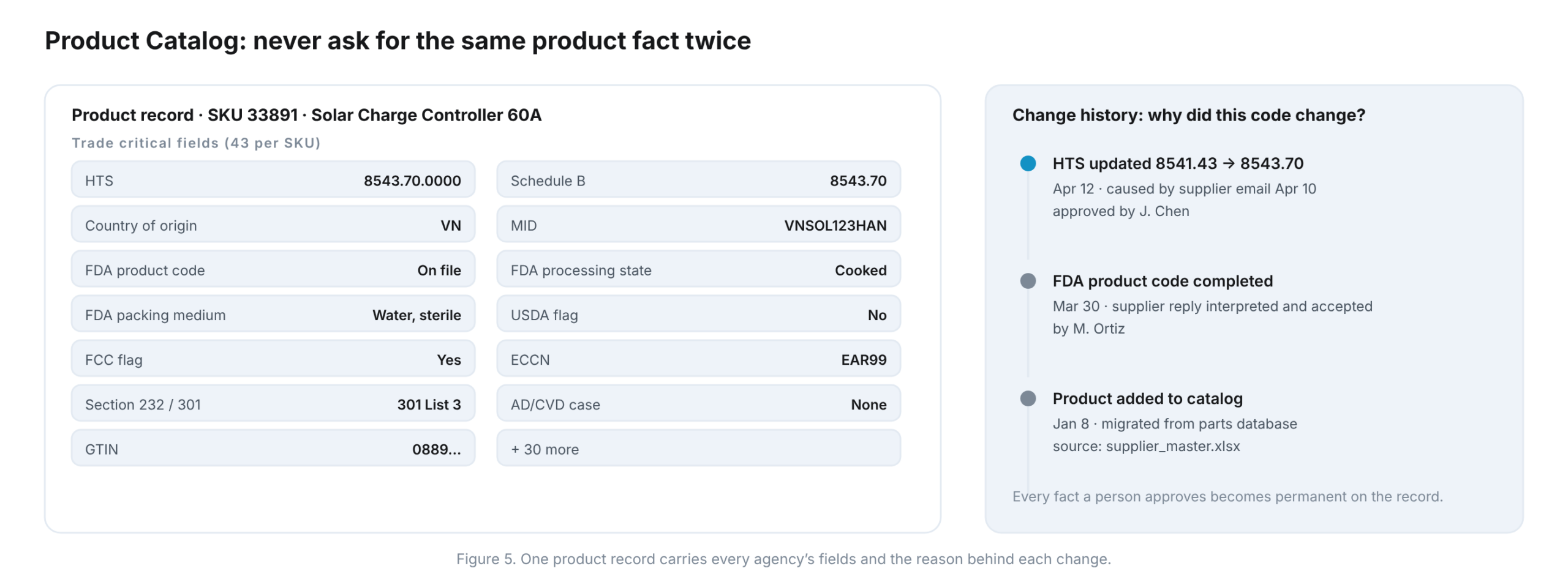
One compliance lead asked for something I had not planned: a feedback mechanism. When the system suggests a PGA answer or a code, the user confirms or rejects it. The system learns the importer’s pattern. That request is now on our roadmap.
We also worked with trade counsel on how this should be positioned. Written SOPs. Final decisions and responsible supervision stay with the broker. The system never files.
The licensed broker still decides. The system shows its reasoning.
What Good Customs Brokerage Automation Looks Like
Here is the workflow we are putting in front of brokers now.
- The email lands. Every attachment is classified.
- Parties are matched to TMS organization records. Low-confidence matches are flagged for review. Duplicates resolve to the branch’s preferred record.
- Missing data is proposed from other emails in the thread, for approval.
- Product codes are matched to the product database. Mismatches are exceptions.
- Compliance checks run before the entry is built: denied party, AD/CVD, and tariff changes from the latest CSMS messages.
- Clean work goes straight through. ISFs and entries with no exceptions go to the TMS without manual approval.
- Everything else goes to a person, with the evidence attached.
The organization and product databases sync every night so the matching stays current.
A High-Level Estimate of the Benefit
I want to be careful here. These are assumptions to validate on your own files, not a promise. Every brokerage is different.
| Task | Manual today (minutes) | With Traffic Desk (minutes, exceptions only) | Saved per transaction |
|---|---|---|---|
| ISF filing | 12 | 3 | 9 |
| Entry preparation, typical invoice | 30 | 10 | 20 |
Take a brokerage filing 30,000 entries and 15,000 ISFs a year.
- ISF: 15,000 times 9 minutes is about 2,250 hours.
- Entries: 30,000 times 20 minutes is about 10,000 hours.
That is roughly 12,000 hours a year. At 2,000 hours per person, that is about six people of capacity. Not six people fewer. Six people redeployed to the work that needs a license and a judgment call.
I have left classification out of the table on purpose. We have not timed it on real parts yet. When we have, I will publish the number. The benefit I am confident in today is not minutes. It is one classification per part, with the reasoning stored, instead of one per entry writer.
The time is the smaller benefit. The larger ones are harder to count.
- Fewer holds. Gaps are found before submission, not by CBP after.
- One classification per part, not one per entry writer.
- An audit trail that shows who approved what, when, and against which version of the rules.
- A new book of business that scales without a hiring plan.
What I Would Ask Any Vendor, Including Us
- Show me party matching on my own duplicate organizations.
- Show me a PGA field carried forward on a product code.
- Show me a rate change flagged before the entry, not after.
- Show me the gate where my licensed broker decides.
- Run it on my last 20 ISF emails and compare to what I filed.
If a vendor cannot do that on your files, keep your current process.
We are running exactly this test with a brokerage now. I will share what we learn.
Run the test on your own files: book a Traffic Desk walkthrough
Frequently Asked Questions
What Is an ISF Filing?
An Importer Security Filing (ISF), also called 10+2, sends ten data elements about an ocean shipment to U.S. Customs and Border Protection 24 hours before the container is loaded on the vessel bound for the United States.
Why Is the Customs Brokerage Desk Hard to Automate?
Reading the invoice is the easy part. The hard part is matching parties to the right TMS organization record, finding data that only exists in another email, carrying PGA data forward on product codes, applying importer-specific rules and catching tariff changes before the entry goes out.
Does Traffic Desk File ISFs and Entries With CBP?
No. Traffic Desk prepares ISFs and entries and sends clean work to your TMS. Exceptions go to a person with the evidence attached. Final decisions and responsible supervision stay with the licensed broker, and the system never files.
Does AI Decide the HS Classification?
No. HS Code Assist is a research tool. It proposes a code with the GRI steps it applied and the ruling it relied on. The licensed broker makes the decision, and that decision is stored on the product record with the broker’s name.
How Much Time Could a Brokerage Save?
Our high-level estimate for a brokerage filing 30,000 entries and 15,000 ISFs a year is roughly 12,000 hours, or about six people of capacity redeployed to licensed work. These are assumptions to validate on your own files, not a promise.
How Should I Evaluate a Brokerage Automation Vendor?
Ask to see party matching on your own duplicate organizations, PGA data carried forward on a product code, a rate change flagged before the entry and the gate where your licensed broker decides. Then have the vendor run your last 20 ISF emails and compare the results to what you filed.
Related Reading
- Introducing Traffic Desk: The AI Intake Layer for Your TMS
- Traffic Desk
- Deep Cognition for Customs Brokers
- PaperEntry AI Customs
Shiv Ramamurthi is Chief Product Officer at Deep Cognition, the company behind PaperEntry AI and Traffic Desk, the intake layer of Agentic TMS.